
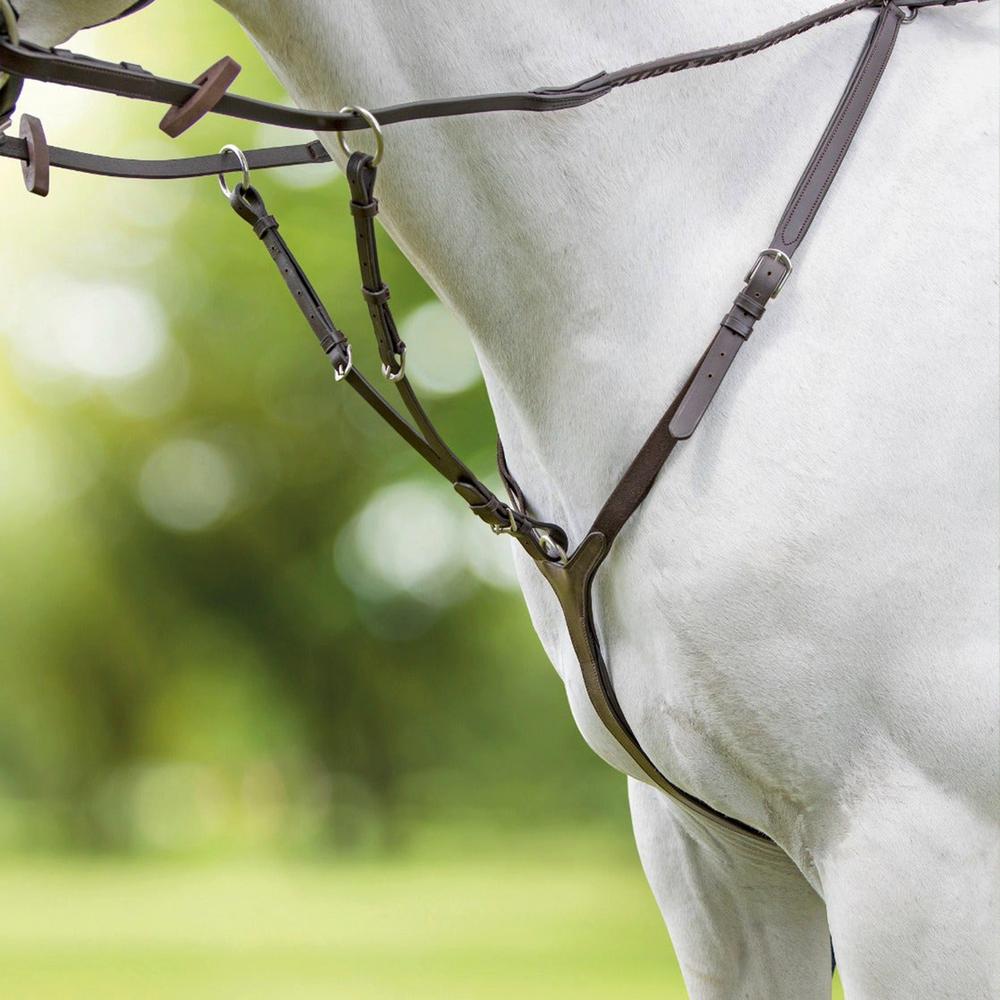
If you’ve ever felt your saddle slide back on a steep hill or shift slightly over a fence, you’ll know how unnerving it can be for both you and your horse. A good breastplate can quietly solve that problem, adding stability and comfort without getting in the way. In this guide we’ll use the Velociti Breastplate Havana as our example, and walk through how to choose, fit and look after a breastplate that really works for your riding.
Why a Breastplate Matters for Everyday Riding
Breastplates are often associated with cross-country or showjumping, but they’re just as useful for hacking, schooling and general riding. Modern horses come in all shapes and sizes, saddles are sometimes swapped between horses, and the demands of modern riding mean your tack has to keep up.
The Velociti Breastplate Havana is designed to tackle one of the most common problems: saddle slip. With fully adjustable side straps that secure the saddle from both sides, it helps keep everything in place when you’re going up and down hills, hopping small logs or simply asking for more impulsion in the school.
It’s not just about security, though. This breastplate is padded at the withers and across the front of the chest, providing cushioned support so there’s less risk of rubbing, even when your horse works up a sweat. That blend of stability and comfort is exactly what you should look for when choosing any breastplate.
If you want a deeper dive into its performance and feel, you can always read our full review of the Velociti Breastplate Havana, but here we’ll focus on general guidance that will apply to most similar designs.
Key Features to Look For in a Breastplate
While every brand has its own take, there are a few core features that should be on your checklist when choosing a breastplate for horse riding.
1. Secure, Adjustable Straps
The whole point of a breastplate is to secure the saddle without restricting your horse’s movement. Adjustable side straps, like those on the Velociti Breastplate Havana, are essential. They let you fine-tune the fit on different horses or as your horse’s shape changes with fitness and age.
- Look for multiple holes for adjustment and well-finished edges.
- Ensure there’s enough reach to attach neatly to your saddle’s D-rings or girth straps.
- Check that the straps lie flat along the shoulder and don’t twist when the horse is moving.
2. Padded Withers and Chest
Padded contact areas are an important comfort feature. The Velociti design uses padding at the withers and front of the breastplate to spread pressure, especially helpful on finer-boned horses or those with prominent shoulders.
When trying a breastplate, run your hand under the padding and imagine how it will feel under a saddle and rider weight. Soft, slightly cushioned sections are more forgiving over long rides and are less likely to rub when your horse sweats or grows a thicker coat.
3. Detachable Martingale
A detachable martingale, as featured on the Velociti Breastplate Havana, is one of the most practical additions you can have. It means one piece of tack can cover hacking, flatwork and jumping simply by clipping the martingale section on or off.
- Use the martingale when you need extra help managing a high or inconsistent head carriage.
- Remove it for relaxed hacks or when working on self-carriage and softness.
- Always ensure the martingale rings sit below the throat and don’t interfere with the reins when the horse is stretching down.
4. Quality Metalwork
Stainless steel fittings, like those used on the Velociti breastplate, are a strong indicator of durability. They resist corrosion from sweat and rain, and they hold their shine with minimal care.
Whatever brand you choose, check that:
- Buckles move freely but feel solid.
- Stitching around fittings is even and reinforced.
- There are no sharp edges that could catch reins or clothing.
Getting the Fit Right: Step-by-Step
A good breastplate should be almost invisible when you’re riding – you shouldn’t feel it pulling or see it restricting your horse’s shoulder movement. Here’s a simple process for fitting a model like the Velociti Breastplate Havana.
1. Start With Correct Saddle Fit
A breastplate is a support, not a cure for a poorly fitting saddle. Have your saddle checked first, especially if you’re seeing significant slipping or your horse has changed shape recently. Once you know the saddle is right, you can use the breastplate to add stability, not to force the saddle into place.
2. Adjust the Neck and Wither Sections
Place the neck strap over the horse’s head so it sits in front of the withers but comfortably behind the shoulder. The padded section at the withers, as found on the Velociti breastplate, should lie flat without digging in.
You should be able to get a hand between the neck strap and the horse’s neck. If it’s too loose, it can slip forward; too tight and it risks interfering with breathing and movement.
3. Set the Chest and Side Straps
The front of the breastplate should sit high enough to avoid the point of the shoulder but low enough not to cut across the windpipe. The adjustable side straps should reach the saddle D-rings or girth straps without pulling the chest strap tight.
- Check you can fit a hand under each strap.
- Walk and trot the horse to see if the straps move excessively or cause any pinching.
- Recheck once you’re in the saddle, as your weight and the horse’s frame will change the shape slightly.
4. Fine-Tune the Martingale (If Used)
If you’re using the detachable martingale, adjust it so that the rings reach up to the horse’s throat when the head is in a normal working position. If they reach the corners of the mouth, it’s too long; if they pull the reins down, it’s too short.
Always test the feel on both reins individually and together at a halt before you set off. The martingale should only come into play when the horse lifts its head higher than normal, not during regular work.
Colour, Style and Matching Your Tack
While function comes first, most riders also care how their tack looks as a set. The Velociti Breastplate Havana comes in a rich havana colour, which typically pairs well with darker brown saddles, traditional hunter-style bridles and country-inspired riding outfits.
If you ride in tan or lighter brown leather, consider how the colour will coordinate. Many equestrians like a subtle contrast rather than a perfect match, especially when boots, breastplates and bridles come from different brands.
Looking After Your Breastplate: Care and Maintenance
A well-made breastplate should last for years if you take a little care of it. Here’s a simple routine that works especially well for padded, multi-strap designs like the Velociti Breastplate Havana.
- After each ride: Wipe sweat and mud off with a damp cloth, particularly under padded sections and around buckles.
- Weekly or fortnightly: Use a gentle leather cleaner, then apply a suitable conditioner, keeping products away from elastic or heavily stitched areas if present.
- Seasonally: Check all stitching, especially near stainless steel fittings and high-stress areas like the martingale attachment and side straps.
- Storage: Hang the breastplate on a broad hook or over a saddle rack so the straps don’t crease sharply.
Regular care not only keeps the leather supple and good-looking but also ensures the padding stays soft and comfortable against your horse’s skin.
How a Breastplate Fits Into Your Overall Riding Kit
Your breastplate is just one piece of the bigger picture when it comes to riding comfort and security. The rest of your kit matters too – particularly your own footwear and your horse’s bitting and bridle set-up.
For example, solid, supportive boots like the Brogini Women's Warwick Pull On Wide Country Boot can make a real difference to your stability in the saddle and around the yard. While they sit in a different product category, they complement the security offered by a breastplate by giving you a confident leg position and good grip in the stirrup.
On the horse’s side, your choice of bit influences contact and balance. A model such as the Shires Port Weymouth is designed for double-bridle setups and more advanced work, where fine-tuned stability and communication between horse and rider are crucial. If you’re riding at that level, having your tack – from bit to breastplate – working in harmony becomes even more important.
Comparing the Velociti Breastplate Havana with Alternatives
Breastplates themselves can vary widely in style, from simple hunting breastplates to modern competition-focused designs. The Velociti Breastplate Havana sits comfortably in the middle: a versatile, adjustable, padded breastplate with a detachable martingale, suitable for a mix of hacking, schooling and jumping.
When you compare it to alternatives in your tack room or local shop, consider:
- Adjustability: Does it have as many points of adjustment as the Velociti, or is it more fixed in shape?
- Comfort features: Are the withers and chest padded, or will you need to add a cover or risk rubs on longer rides?
- Hardware quality: Are the fittings stainless steel or a cheaper alloy that might dull or rust over time?
- Versatility: Does it offer a detachable martingale like the Velociti model, or will you need separate pieces of tack?
The right choice will depend on your discipline, how often you ride, and whether you prefer a minimal look or a feature-rich design. If you’d like more detail on how the Velociti performs in real-world use, you can read our in-depth Velociti Breastplate Havana review for hands-on impressions and long-term feedback.
When to Consider a Breastplate (and When You Might Not Need One)
Not every horse and rider combination needs a breastplate all the time, but there are clear situations where they become highly recommended.
- Hacking on hilly terrain: Uphill and downhill work can encourage saddles to creep backwards or forwards.
- Jumping and cross-country: The saddle experiences more dynamic forces and can shift without extra support.
- Rounder or low-withered horses: These shapes are naturally more prone to saddle movement.
- Shared or multi-use saddles: If one saddle is used on multiple horses, a breastplate can add an extra margin of security.
You may not need a breastplate for short, gentle schooling sessions on a well-fitted saddle and a horse whose shape suits your tack perfectly. But many riders find that once they’ve added a quality breastplate like the Velociti Havana to their setup, they don’t want to go back – the extra stability and peace of mind quickly becomes part of their standard kit.
Choosing a breastplate is ultimately about striking the right balance between security and comfort for you and your horse. If the Velociti Breastplate Havana has caught your eye, be sure to explore our full Velociti Breastplate Havana review, and take a look at related gear like the Brogini Warwick country boots and Shires Port Weymouth bit to complete your riding setup with confidence.